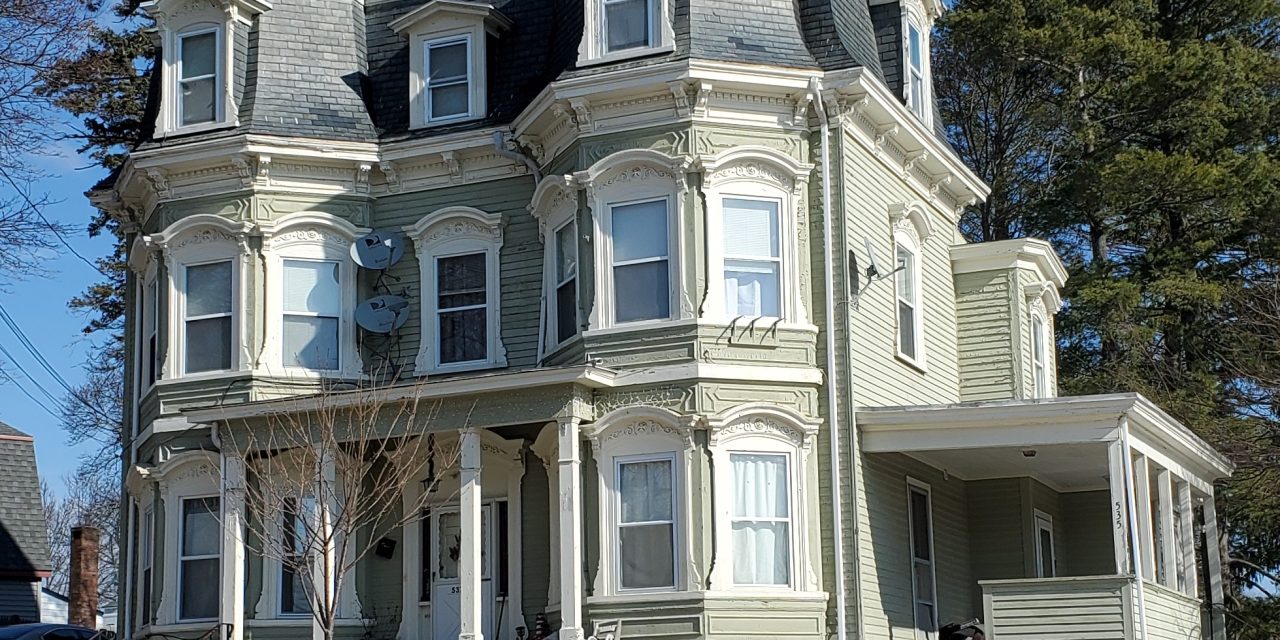
The elegant and ornately trimmed house at 535-537 Prospect St., is one of the finest examples of French Second-Empire architecture in Methuen. It was built in 1876 for Joseph E. Buswell, a prominent Methuen resident around the turn of the last century.
Joseph E. was a seventh-generation descendant of some of the first English settlers in Salisbury in 1638, and a third-generation owner of the Methuen property. His grandfather, Joshua Buswell, came to Methuen in 1799 and purchased 39 acres of farmland on Prospect Street. His two-story colonial-style house was located on the site of the present structure opposite Brook Street.
Joshua died in 1836, leaving the property to his 18-year-old son, Joseph. Joseph lived in the home and worked on the farm until he died in 1875. He, in turn, left the property to his son, Joseph E.
Joseph E. Buswell was born in 1841. He spent his early years attending school and working on the farm with his father. Upon graduating from Lawrence High School (Methuen had no high school at the time), he enlisted as a 19-year-old volunteer at the beginning of the Civil War. He served with the First Massachusetts Heavy Artillery Regiment, where he advanced to the rank of First Lieutenant. He was mustered out of service in August 1863, whereupon he returned to the family farm.
In 1865, he married Julia Merrill, daughter of Washington and Abiah Merrill. Washington was a prominent hat manufacturer and farmer on Prospect Street (his impressive house and barn still exist at 585 Prospect St.). Joseph and Julia had five children, four of whom survived to adulthood.
Joseph E. graduated from Boston University Law School in 1873. He practiced law in Methuen until illness forced him to return to farming. Shortly after inheriting his father’s property, he had the old farmhouse removed (which still exists at 15 Milk St.) and replaced it with the present three-story home. The builder was Millett G. Copp of Methuen, builder of many fine homes and other notable buildings, including what was then known as the James S. Dodge Building at 271 Broadway at the corner of Lawrence Street (now Marbella Park Place).
Later in life, Joseph E. dedicated himself to public service. In 1897, he was elected as one of the town’s three selectmen. He went on to serve as Methuen’s representative in the Massachusetts General Court from 1900 to 1902. Meanwhile, he served on various important town boards and committees. He was particularly active in school matters and in fire protection efforts for the Prospect Street area. He served on the committee for the new Central Fire Station in 1899. In 1904, he was appointed an agent for the State Board of Pharmacy, a position he held until about 1916. His wife, Julia, died that year.
After he died in 1923 at age 82, his children subdivided the farm property into 101 house lots. The 1923 Buswell Acres Plan encompassed the area from Prospect Street to Milk Street between Albion and East Prospect streets. The plan included four new streets: Buswell Avenue, Coolidge Street, East Prospect Street and Merrill Avenue (later renamed Houston Avenue). Several existing properties on Prospect Street were excluded, however, including the Buswell home and the estate of the late Lawrence mayor and undertaker John Breen. Breen Street now surrounds that property.
In drawing up the plan, the Buswells took steps to regulate the type of homes to be built on the individual lots. Deed restrictions allowed for only one single or two-family home. Two-family homes could only be side-by-side structures – no double-deck dwellings. Flat roofs were not allowed. All buildings had to be at least 20 feet from the street and no less than 5 feet from abutting boundary lines. Only one garage was allowed with a capacity of not more than three motor vehicles. No garage could be used for storage or motor vehicle repair. And no building could be used as a store. The obvious intent of these restrictions was to keep the neighborhood free of large tenement buildings and commercial businesses. Many other neighborhoods in the Prospect Street area had similar restrictions.
The Buswell children converted the family home into a two-family residence. Two of them, B. Clinton Buswell and his sister Grace, lived there for several years before moving to nearby homes. They rented the house to tenants afterward.
Grace Buswell was an unmarried schoolteacher at the nearby Merrill School on Prospect Street opposite Timber Lane. The one-room schoolhouse, built in 1873, was named after her maternal grandfather, Washington Merrill. After she died in 1952, her estate sold the Buswell home to Frank T. and Mary A. Rourke. It remained in the Rourke family until Mary died in 1989.
The J.E. Buswell House was placed on the National Register of Historic Places in 1984.
NEXT TIME A magnificent house with a spectacular view!
Ken Doherty is a lifelong resident of Methuen. He served on the Methuen Fire Department from 1980 to 2010. He is the Fire Department historian and a former member of the Methuen Historical Commission. He wrote “Á History of Methuen and its Fire Department” in 1996. He is retired and still living in Methuen with his wife, Paula.

Joseph E. Buswell
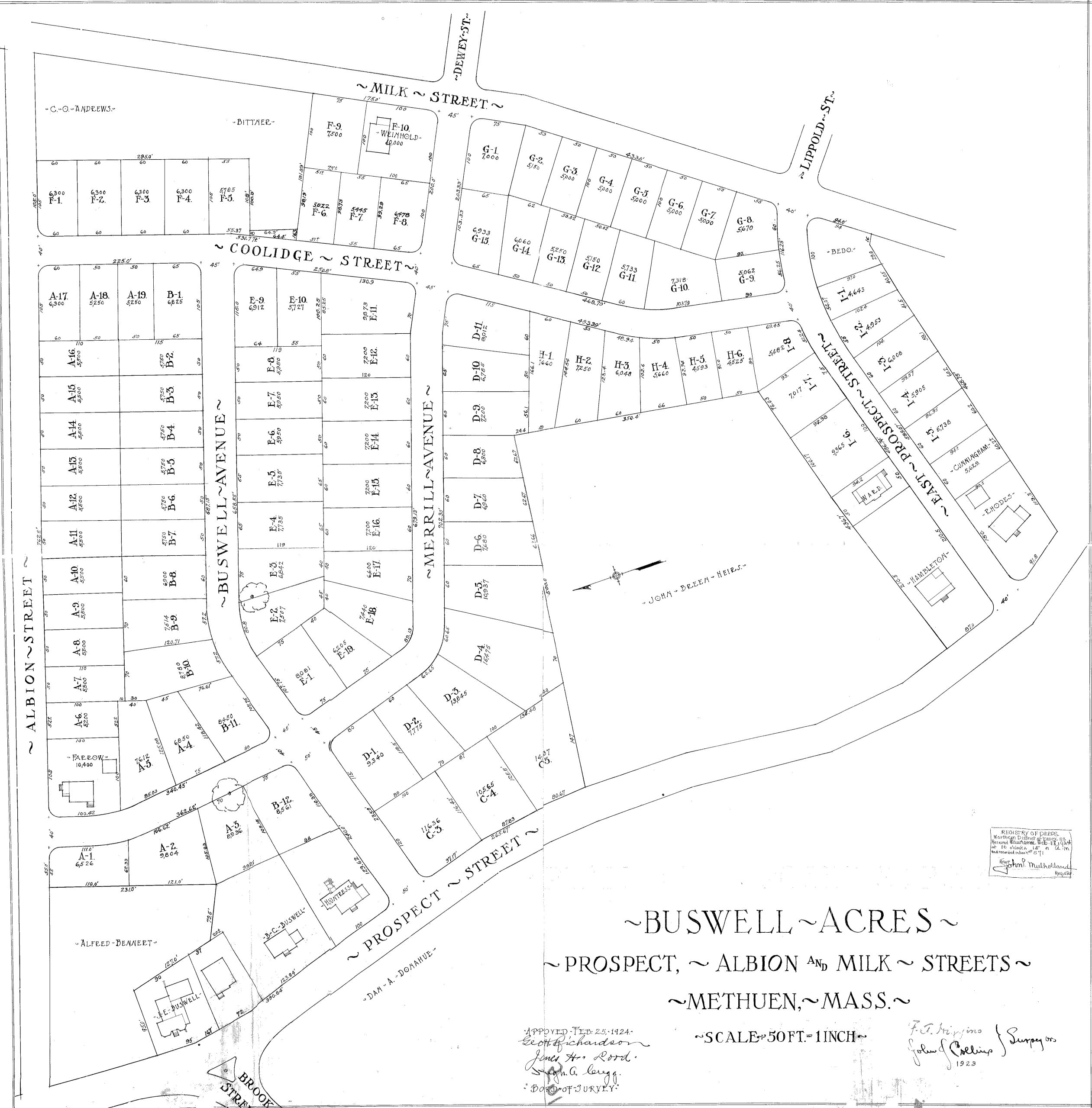
Buswell Acres Plan #571 (1923)