St. Theresa’s Roman Catholic Church, 22 Plymouth St., is one of the area’s truly magnificent traditional-style church buildings. It was built in 1935-36 as a mission church of Ste. Anne’s Parish in Lawrence to serve the growing Franco-American population in the Glen Forest and Tower Hill areas.
Ste. Anne’s was formed in Lawrence in 1871 as a “national parish” serving the French-speaking Canadian immigrant population centered in the city’s Haverhill Street area. In 1925, the parish expanded into Methuen’s Glen Forest area with the construction of a large, four-story orphanage at 100A Haverhill St., to care for orphans and children of the city’s mill workers. Adjacent to that building, they erected a three-story parochial school building named Ecole St. Jean Baptiste. The Sisters of the Good Shepherd order ran the orphanage and the school. The name of the school was changed to St. Theresa’s in 1936 when the new parish was formed.
Soon after the orphanage opened, many parishioners in the surrounding neighborhoods began attending Mass in its small chapel. As the parish’s population in the Glen Forest area grew, Ste. Anne’s leaders realized a need for a separate church building there. In 1934, the Boston Archdiocese purchased the corner lots at Plymouth and Dawes streets for the construction of a new church. The cornerstone was laid June 6, 1935, in front of a joyous gathering of a reported several thousand men and women.
The building’s architect was Joseph G. Morissette of Lawrence. He was one of the architects of the majestic Sacred Heart Church, then under construction in South Lawrence. Sacred Heart was also a French-speaking mission church of Ste. Anne’s. Another was Our Lady of Mount Carmel at Union and Lowell streets in Methuen.
The exterior of St. Theresa’s church measures 120 by 50 feet. It is constructed of blond-colored brick with a dark slate roof. Inside, the nave measures 20 feet from the floor to the top of the arched ceiling. It was built with a seating capacity of 700, but several of the pews have been removed in recent years to accommodate modern customs. The organ, originally installed in the choir loft at the back of the church, came from the former Methuen Theater in Railroad Square. It was removed from the church several years ago.
A roomy parish hall in the basement features a stage and a well-equipped kitchen. The various church societies and other groups have held numerous events there over the years, including suppers, stage performances, movie presentations, school functions, social activities, bazaars and holiday events.
The church is named for St. Therese of Lisieux (1873-1896), also known as St. Theresa of the Little Flower. She was only 24 when she died of tuberculosis. She is a much-venerated saint among Catholics. Above the front doors of the church is the Latin inscription “Quia cum essem parvula placui Altissimo,” which translates to “When I was a little girl I pleased the Most High.”
The church was officially dedicated April 20, 1936, by Bishop Thomas Wade. Priests from the Marist order ran the church and the parish. The Rev. Regis Sirois was the first pastor.
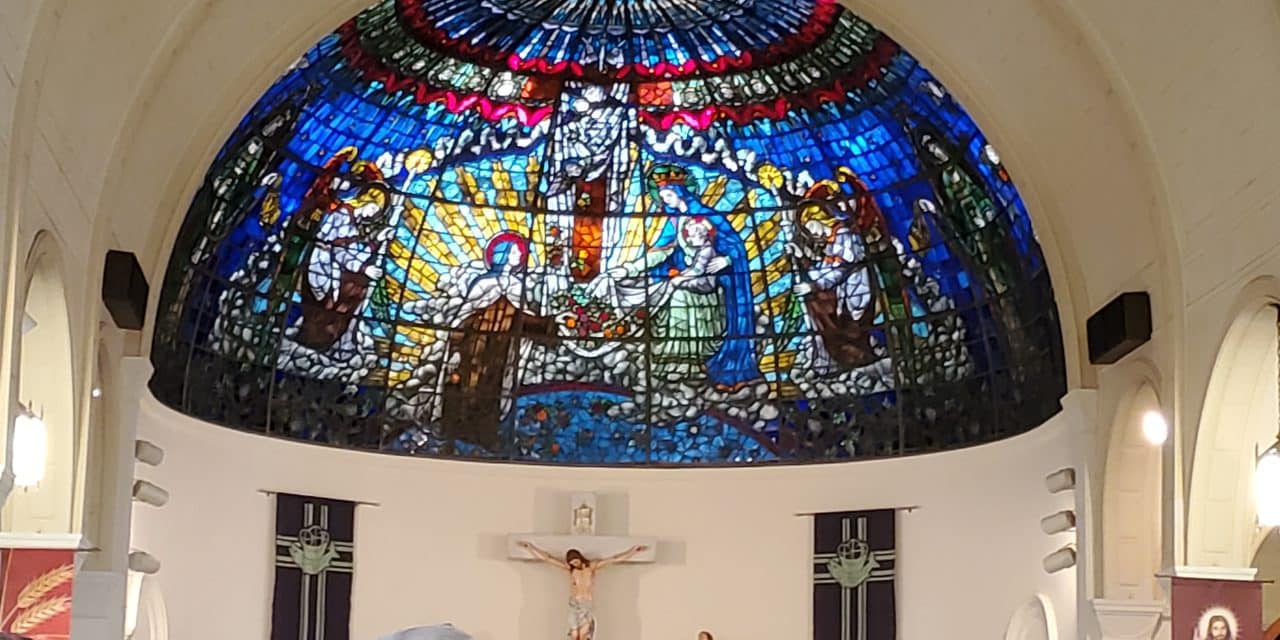
The church’s most spectacular feature is the stained-glass half-dome over the sanctuary. It depicts the Blessed Mother with the child Jesus greeting St. Theresa into heaven. The young girl is shown picking roses from Mary’s mantle and dropping them to the earth below. She is quoted as saying, “When I die, I will send down a shower of roses from the heavens, I will spend my heaven by doing good on earth.” Rising behind them is a brown-colored cross with a draped white cloth showing the face of Jesus. Four guardian angels – two standing, two kneeling – are positioned on the left and right sides, while 34 different cherub faces are looking down from above. The designer of this incredible work of art is currently unknown.
In 1945, the parish installed 12 sets of beautiful stained-glass windows on the exterior side walls. They were designed by noted stained-glass artist John Terrence O’Duggan of Boston. Each window features two panels with scenes from the Bible. The windows were gifted by parishioners in memory of loved ones. Their names are inscribed on the panels.
St. Theresa’s School originally taught grades one through twelve. The high school grades were eliminated in 1952. Religious education (catechism) and French language classes were part of the regular curriculum for all grades. It continued as a grade-one-through-eight school until the end of the 1969 school year. The town then occupied it briefly as the Glen Forest public school. It is now an educational facility of St. Ann’s Home.
By the late-1900s, church attendance had dwindled in many parishes in the region. Many churches closed or merged with other parishes. Ste. Anne’s closed in 1991. Within a few years, two of its local mission churches also closed: Our Lady of Mount Carmel in Methuen in 2000; Sacred Heart (suppressed) in 2005. In 2000, St. Theresa’s parish merged with St. Augustine’s parish on Ames Street in Lawrence to form Our Lady of Good Counsel (OLGC) parish. The Marist priests left St. Theresa’s at that time. The parish was then led by Augustinian priests until 2008.
OLGC is now a “territorial parish” of the Archdiocese of Boston. Regular Masses and other religious services continue to be celebrated at both St. Theresa’s Church and St. Augustine’s Chapel under the direction of the Rev. Gregory Vozzo, pastor.
St. Ann’s Home and School, now privately operated, is celebrating its 100th anniversary this year (2025). Our Lady of Good Counsel Parish is also celebrating its 25th anniversary this year. St. Theresa’s Church turns 90 years old in 2026.
Ken Doherty is a lifelong resident of Methuen. He served on the Methuen Fire Department from 1980 to 2010. He is the Fire Department historian and a former member of the Methuen Historical Commission. He wrote “Á History of Methuen and its Fire Department” in 1996. He is retired and still living in Methuen with his wife, Paula.
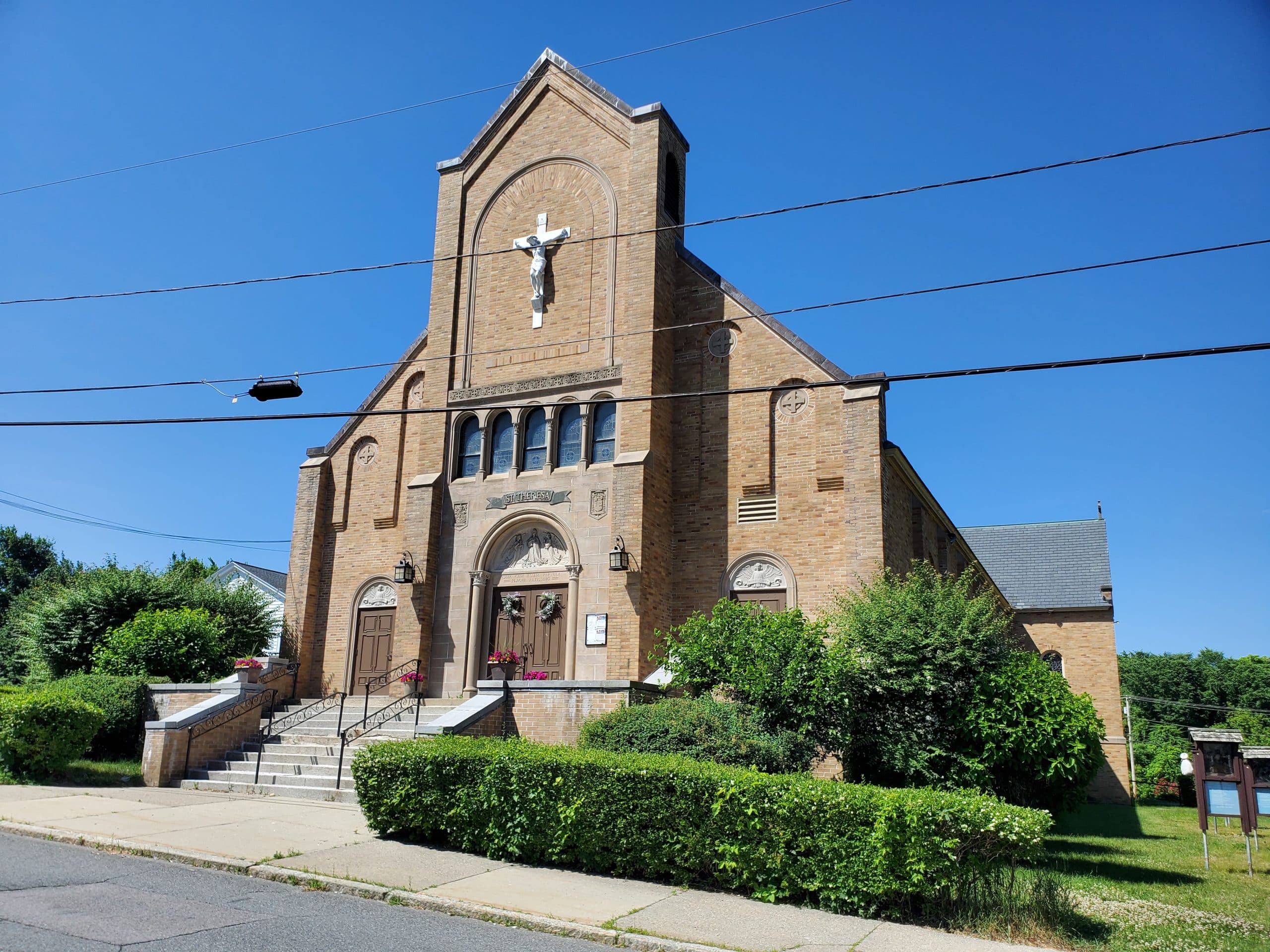
St. Theresa’s Church, 22 Plymouth St., turns 90 years old in 2026. Photos: KHD, 2024