As spring begins to bloom here in New England, I think of a century-old rhyme. “Spring showers bring May flowers.”
Symbolizing the month ahead and its critical role of producing new growth for us, and every living creature, I relate this rhyme to our hobby in a couple of ways. Spring showers are always a refreshing sight to metal detectorists as they justify no more frosty frozen grounds to chop through. Above-freezing temperatures and rainfall are the beginning of melting away that frozen past – literally and figuratively.
Take a farm field that has been turned over in the fall, for example. It gets tilled, covered with a layer of hay perhaps, and forgotten about until it’s planting season. When the spring showers begin, the hay starts to get washed out and so do the top layers of dirt. As this is occurring, outside of metal objects deeper in the ground, it could produce artifacts that we spot with our eyes. Just like our metal detectors, our eyes scan the ever-changing ground, waiting to be enlightened by a target or surprised by a centuries-old antiquity – items that could be working their way up from extravagant depths for years and years, waiting for us to see them. We call them “surface finds” because they are, well, finds on the surface.
Surface finds can be quite old and have notably interesting origin stories. Items like Native American arrowheads (could date back as far as 15,000 years ago), clay pipes (16th century) and marbles made of clay or glass (17th to 18th century). That makes us, as metal detectorists, the likely first person to touch some of these objects since the maker created them. I’ve been this person for Native American arrowheads and kettle points (arrowheads made from metal). Imagine you’re the first human to touch an arrowhead likely made by a Native American up to 15,000 years ago before modern human life was even a figment of imagination to anyone or anything! It gives me chills just thinking about it. That would put us at 13,000 BC, which even makes me think about the land before us, and the origins of Native Americans. But that’s another story for another day.
In a different sense, the frozen past is just being defrosted for us to cut through and uncover, producing more stories to tell you, the readers, and stories to tell future generations of upcoming metal detectorists.
As we embark in this new season of digging, we can only hope we find some of the unique items mentioned and others.
For a little fun, as the new season began last year I set my sights on an item I had never found: the illustrious 20-cent piece. Though I didn’t find it (I really didn’t expect to as it’s almost impossible to find), I will happily set my goals on trying to find it this year as well. I always like to set my goals higher so I can consistently work toward them.
The next time you’re out and about, keep your eyes on the ground! You don’t have to be in a farm field to find treasure underneath your feet. It can be anywhere!
Methuen father/son treasure hunters Steve and Jonathan Stewart were the August 2019 MethuenLife cover story. They run YouTube, Facebook and Instagram accounts called Mass Metal Detecting and have followers around the globe. They love to save history and enjoy talking about it. If you’d like to invite them to your property for a hunt, you may be included in a future article! Please drop them a note via MethuenLife@msn.com.
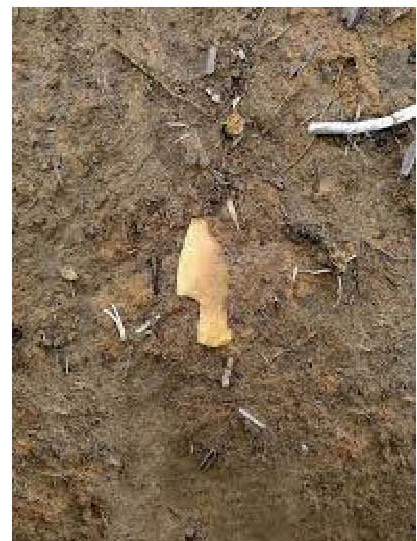
Here’s a surface find of a Native American arrowhead in a farm field. Metal Detectives photo