As we’ve expressed in many of our articles, metal detecting isn’t always sunshine and rainbows. This goes for a few aspects in the hobby, but I want to narrow in on the challenge of a deep signal.
Our metal detector coils (circular or elliptical disc at the end of the shaft that emits a magnetic field) come in many shapes and sizes. The one I was using at the time of this story was a NEL (a Ukrainian company that sells coils and is currently out of business) tornado coil. This one has a more circular shape, around a foot across in both directions, and can go up to 2 feet down signal-wise. In other words, it has the capability to pick up a bigger signal.
Back in the early 2010s, before we even had social media, we went on a hunt in Methuen on a local farm. Amassing usual finds such as clad coinage and some fun old toy guns, I got a deep signal. It was low, to a slight mid tone (40-60) range on my VDI (Visual Display Indicator). But it was strong enough for me to want to check out what was down there. Thus, I begin digging.
As I started going down, 3 inches turned to 6, and 6 turned to a foot. Next thing I knew, there was a mound of dirt next to me, and I questioned how much further I must dig. I stuck my pin pointer (smaller handheld metal detector) down into the hole to see if I was close. To my surprise, I didn’t hear anything. So I took another HUGE scoop of dirt out of the hole, stuck my pin pointer in again and finally heard slow beeping, signifying I was within a few inches of the target.
As I began brushing dirt away, trying to put a finger on what it is, I noticed how heavy it was. I finally got a hand on it and pulled out something that made me gasp for a second and say, “Wow, that’s awesome!”
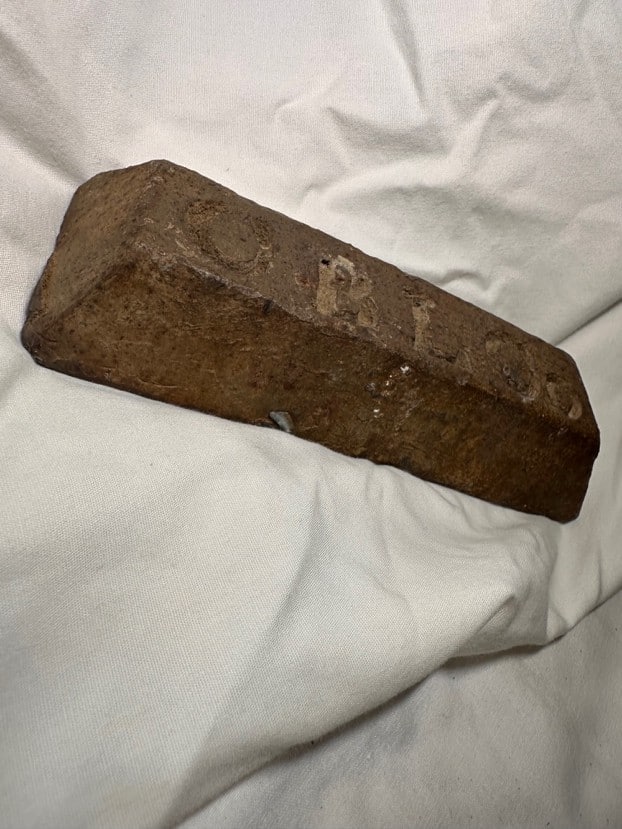
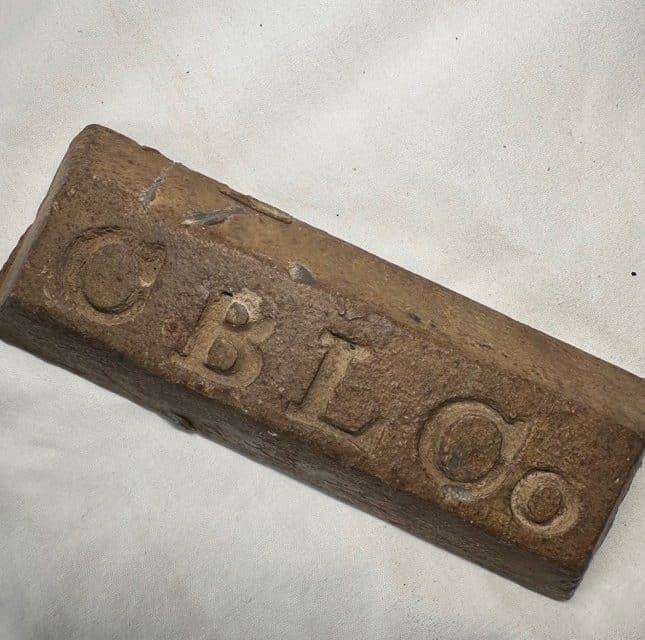
I found a full, 4-and-a-half-pound lead ingot! This was my first ever, and still my only ingot of any metal or material I’ve found. Upon further research, this stamped “CBL Co” ingot has a New England history! They were produced by the Casco Bay Lines Company back around 1900. The CBL Co., was based out of Portland, Maine, and had used these lead ingots as ballast for company vessels. This specific location isn’t necessarily close to a body of water, more so swampland. How did the item get here?
Our best guess is it was used for farm equipment, to melt off a chunk when needed or for weighing down things like it did on the vessels. Nonetheless, it is a cool piece of New England history, found right here in Methuen!
This also goes to show to you that if you find yourself metal detecting and stumble upon a target that you’ve been digging for a while and haven’t had results, to keep going! It could be something really cool and unique, like a whole lead ingot! We hope everyone out there, if metal detecting, is having success and staying hydrated in the summer heat! Good signals to everyone.
Methuen father/son treasure hunters Steve and Jonathan Stewart were the August 2019 MethuenLife cover story. They run YouTube, Facebook and Instagram accounts called Mass Metal Detecting and have followers around the globe. They love to save history and enjoy talking about it. If you’d like to invite them to your property for a hunt, you may be included in a future article! Please drop them a note via MethuenLife@msn.com.