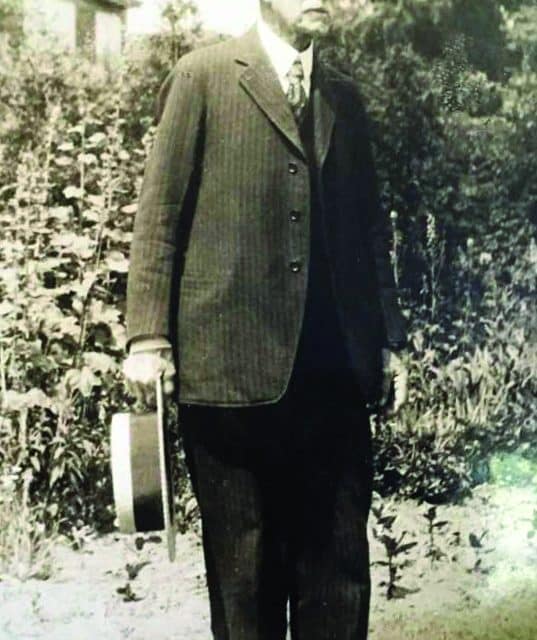
Editor’s note: This is the second of a three-part series on the Tenney brothers of Methuen.
George Washington Tenney, born in 1835, was the second of four sons born to John F. and Hannah (Woodbury) Tenney of Salem, N.H. He grew up on the large family farm on Old Rockingham Road with older brother Daniel W., and younger brothers John Milton (known as J. Milton) and Charles H. By the 1850s, the family was splitting their time between the Salem farm and Methuen. The 1850 U.S. Census shows them briefly living in Methuen, where John F. worked as an operative in the Methuen Company cotton mill, as did Daniel, 17, and George, 15.
From about 1860 to 1865, George and Daniel worked in the market gardening business in Chicago, Ill. They returned to Methuen after the Civil War and worked in a shoe shop on Hampshire Street, likely in the back of their father’s hardware and grocery store.
Shoe and boot manufacturing was a thriving and prosperous industry in Methuen in the mid-1800s. The 1860 U.S. Products of Industry Census for Methuen listed five shoe manufacturers producing 417,000 pairs of shoes and employing 547 workers. About 21 percent of the town’s 2,566 population was engaged in making shoes.
In those days, shoes and boots were mostly constructed by piecework. Farmers and their families shaped and prepared the uppers in their homes and workshops, then sent their work to the shoe shops in the village to be sewn onto the soles and finished. Most of the grocery stores had shoe shops out back to boost profits and to keep the employees busy during slow times.
In 1867, George and Daniel bought a small lot at 2 Charles St., and built a four-story shoe factory there. They streamlined the business by combining all phases of shoe manufacturing under one roof. Each floor of the building had a separate function. In 1870, their fledgling Tenney & Company factory produced over 30,000 pairs of shoes and boots, while employing almost 50 men, women and youths. The business prospered, and the two men reaped large profits. By 1880, Methuen’s shoe manufacturing was mostly concentrated in three “all-in-one” shoe factories.
But the town’s once-booming shoe industry was quickly coming to an end. For many years, Methuen shoe makers made mostly heavy, durable shoes and boots for women, misses and children. That type of footwear was particularly popular in the South and the rugged western frontier. But those styles fell out of fashion in the post-Civil War years. The Methuen factories were unable to transition to the newer and ever-changing styles of footwear. Meanwhile, large shoe factories in Brockton, Lynn and nearby Haverhill captured a major share of the country’s shoe market. By 1883, the Tenney factory was the only one still in operation here. George and Daniel retired in 1888 and later sold their factory, closing the chapter on Methuen’s shoe industry. George was only 53 at the time, but financially secure for the remainder of his life.
George and Daniel lived together for several years in a handsome, two-story home they bought in 1866 at the corner of Broadway and Pleasant Street. George married Alzadia M. Tourtelot in 1872. Two years later, he sold his half of the property to Daniel and purchased the former home of the late shoe manufacturer Josiah G. White on the opposite side of Broadway.
George lived in the two-story, colonial-style house with his wife and two children until 1891, when he had the building removed to build a large, three-story mansion on the site. The old house was moved to 7 Ingalls Court, where it remains today. Meanwhile, Daniel had already replaced his home with a stately mansion, and their younger brother, Charles H., was building his majestic Grey Court mansion a short distance away off of Pleasant Street. In 1903, brother J. Milton also built a large and magnificent mansion at 10-14 Pleasant St. In the early 1900s, the Tenney brothers owned four of the finest homes in Methuen.
George’s new home – high on the Broadway hillside – gave him a spectacular view of the village and the Merrimack Valley below. Census records show that he employed live-in servants to tend to the family and the spacious residence.
George took an active role in town affairs in his retirement years. He and his three brothers were instrumental in establishing an underground public water supply system for the town in 1893. He was a member of the new Central Fire Station committee in 1899. He also served on the town’s street light, sewer and playstead committees for several years. In addition, he was a trustee of the Nevins Home for the Aged, the Nevins Memorial Library and the Walnut Grove Cemetery. He was regarded as one of Methuen’s most respected citizens.
Alzadia died in 1919 at age 79. George, 83, continued to live in the house on Broadway with his daughter, Helen, and her husband, Dr. Roy V. Baketel. Roy ran his medical practice for many years in the Odd Fellows Building on Hampshire Street, just below their home. George’s son, John F., was a Harvard Law School graduate working for the C.H. Tenney Hat Company in New York.
George died in 1927 at age 92, the last of the four Tenney brothers. He was buried in the Tenney family section at the lower end of Walnut Grove Cemetery.
Helen & her husband lived in the Broadway home until 1946. Thelma A. Muller purchased it in 1949 and turned it into a nursing home (later the Blenwood Nursing Home). She also purchased Daniel’s former house across the street in 1954 and turned that one into a nursing home (the Broadway Nursing Home). She sold both properties in 1961 to out-of-town nursing home partners. The Blenwood Nursing Home closed in the late 1990s.
The former George W. Tenney mansion at 302 Broadway is now an office building owned by Attorneys Anthony and Kathleen DiFruscia. Except for a large addition to the rear and a few minor alterations, the exterior of this grand and very well-maintained building remains very much as it was when it was originally built.
Ken Doherty is a lifelong resident of Methuen. He served on the Methuen Fire Department from 1980 to 2010. He is the Fire Department historian and a former member of the Methuen Historical Commission. He wrote “Á History of Methuen and its Fire Department” in 1996. He is retired and still living in Methuen with his wife, Paula.

This undated photo shows the George Washington Tenney home at 302 Broadway, near the current Methuen Square.
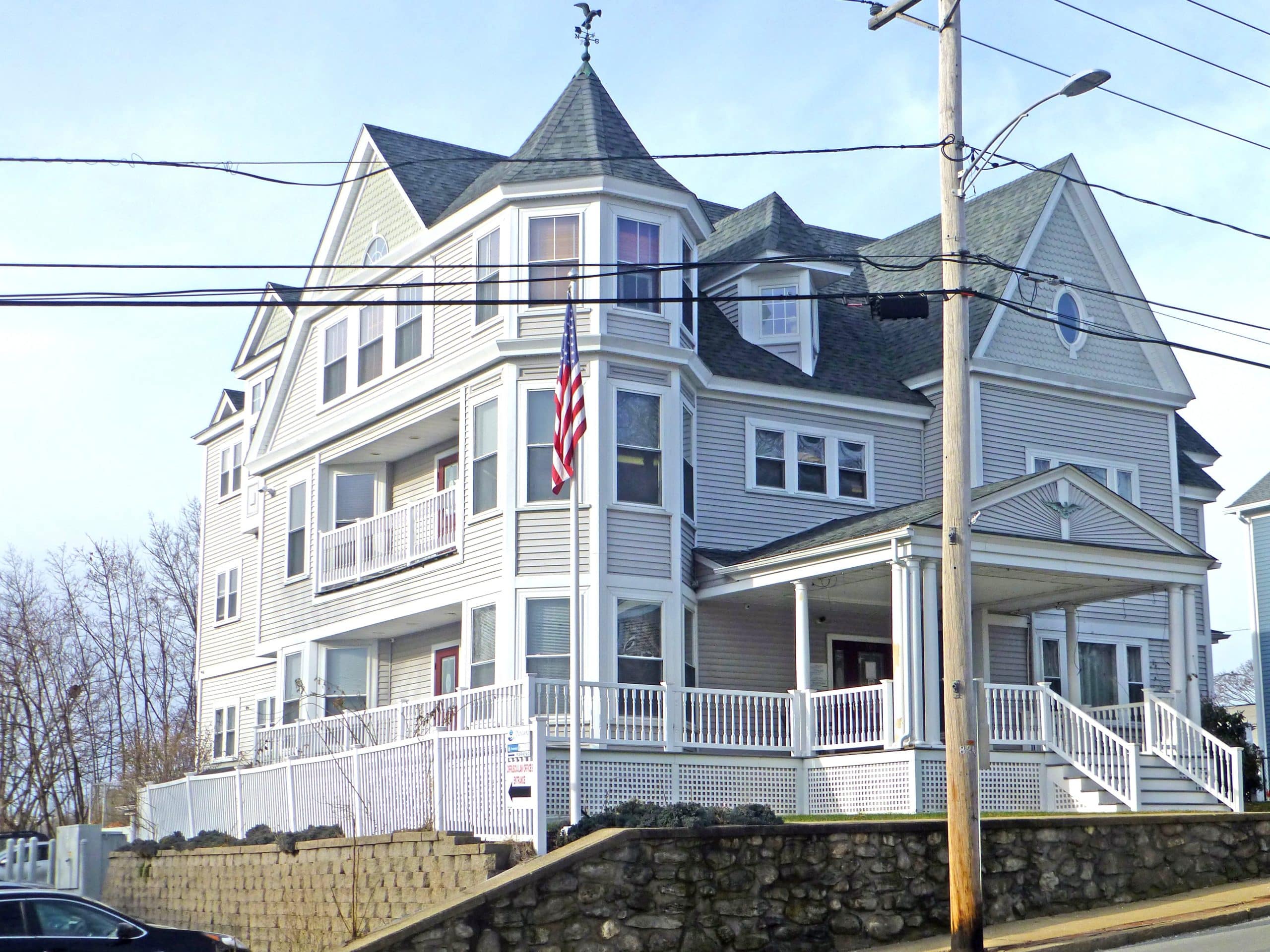
Today, the structure houses an office building owned by Attorneys Anthony and Kathleen DiFruscia. Except for a large addition to the rear and a few minor alterations, the exterior of this grand and very well-maintained building remains very much as it was when it was originally built. Ken H. Doherty photo, 2021