Editor’s note: This is Part 3 of a three-part series on Methuen millionaire Edward F. Searles. The city recently purchased 19 acres of his historic Searles Estate (including 12 buildings and structures and $1 million in artwork) for $3.25 million and its potential is currently being explored. A Searles Estate Future Use Advisory Committee was recently established by Mayor DJ Beauregard.
According to an article in the New York Times in 1927, Edward Searles’ heir, Arthur T. Walker, was born in Canada in 1877. He came to Brooklyn, N.Y., in 1889 where he started as a stenographer. Not long after, he met Edward and became his business manager. He was earning an annual salary of $10,000 in that role by the time Edward died. He was unmarried. Despite his generous income, he continued to maintain a frugal lifestyle in a rented two-room apartment in Brooklyn. Even after he inherited the bulk of Edward’s estate, estimated at $15 million, he never changed his lifestyle. A reporter mentioned that he never even bought a new piece of furniture for his apartment six years after inheriting his fortune. Seemingly surprised at his huge windfall, he became more reclusive.
After settling hotly contested court challenges to the will, Arthur began selling or donating pieces of the estate. Large parcels of properties such as Highfield and Oakside farms in Methuen were turned over to the Searles Real Estate Trust and later sold.
Arthur didn’t live very long, though. He died suddenly in 1927 of a stroke at age 50 while visiting the Windham castle, aka Stanton-Harcourt. In his will, he left the bulk of his estimated $8.3 million estate (the remainder of Edward’s estate) to his siblings and a niece. Each received an unexpected windfall of over $1 million.
Edward had also willed pieces of his estate to a few other relatives. Besides the 80-room Pine Lodge estate which he left to distant cousin Benjamin Allen Rowland, he also gave his Park Lodge guest house on Lawrence Street next to the Baptist Church to his first cousin and longtime Pine Lodge secretary, Edith Littlefield. She later took up residence at the Red Tavern. Arthur Walker willed the Red Tavern to Edward’s tavern manager, Mrs. Carrie Barnes.
As for Edward’s other properties, Kellogg Terrace at Great Barrington had several owners over the years. It is currently a privately owned residence. The Dream House, aka White Hall, on Block Island had several owners, but it was mostly abandoned around the 1950s. It was destroyed by fire in 1963. His one-time residence in New York City, the Murray Hill Hotel, was razed in 1947.
In the local area outside of Methuen, most of the walls and buildings of his Stillwater property along Pond Street in Salem still exist, although there are now many elegant new homes on the north side of the street by World’s End Pond. On Butler Street in front of the Northeast Rehabilitation Center is a section of a stone wall and a stone bridge. The Stanton-Harcourt castle in Windham, once the home of Castle College for girls run by the Sisters of Mercy, is now a popular site for weddings and functions. Many beautiful stone walls still line the boundaries of this once-vast estate. Just over the border on Berkeley Street in Lawrence, the beautiful Berkeley Nursing Home – which Edward built and donated in 1909 – remains in use today as the Berkeley Retirement Home.
In Methuen, several of his properties, such as Oakside Farm by East and Lawrence streets near the Lawrence border, were subdivided into house lots. Highfield Farm at the top of East Street is now the site of the Holy Family Hospital, Methuen High and Timony schools and the school department’s athletic fields. Several homes line Pleasant View Street on the western side of that property.
Sadly, though, the magnificent Washington Monument was sold in 1958 to Forest Lawn Cemetery in Burbank, California. It once stood on Edward’s beautiful Washington Park at the corner of Lawrence and Park streets (now the site of St. Monica’s church and school).
The former Searles High School on Pleasant Street is now Methuen City Hall. The school’s former athletic field on Lawrence Street, on land Edward once owned, is now the Neil Playground. The Masonic Lodge on Broadway and the Red Tavern on Pleasant Street have recently been renovated into upscale apartments. The Turnpike Hotel and Tavern on Broadway, opposite the Masonic Lodge, (more recently known as the Page Building), is mixed apartments and business offices. The former railroad station on Railroad Street is currently occupied as a business office.
In 1931, famed organ builder Ernest M. Skinner purchased the organ hall and factory on Broadway. He built the famous organ there for the National Cathedral in Washington, D.C. The wooden 3-1/2-story factory was completely destroyed in a massive blaze in 1943. Fire crews successfully prevented the flames from destroying the beautiful brick organ hall and the irreplaceable Great Organ inside. The Methuen Memorial Music Hall Inc., acquired the hall in 1946. The trustees have done an amazing job over the years restoring, preserving and maintaining the building and organ. It is truly the pride of Methuen. Concerts and other events are held there throughout the year. It’s also a popular venue for weddings and private events.
Edward brought the massive 1886 James Treat organ from Great Barrington to Pine Lodge after Mary died. After he died, it was given to First Church Congregational on Pleasant Street, where it remains today. Another of Edward’s Pine Lodge organs was donated to Forest Street Church about 1924. There are at least two more organs on the estate, one of which is said to be still in good working condition. A large James Treat organ used for exhibitions at the organ factory was installed at St. George’s Church on Carleton Street.
In 1922, the Methuen Transcript and New York Times reported that famous American opera singer Geraldine Farrar and her manager visited Methuen looking to buy a castle, specifically Pine Lodge. They stayed for a few days at the Red Tavern. However, nothing came of this venture: The estate wasn’t for sale.
Unfortunately, the Pine Lodge mansion no longer exists. By the 1930s, the structure was said to be badly deteriorated due to roof leaks. It was torn down about that time. However, many of the other spectacular buildings and historical artifacts on the property still exist. The Appleside structure along with Edward’s childhood bedroom remains nestled among several of the later additions.
In 1957, Benjamin Rowland sold the entire estate to the sisters of the Presentation of Mary (a Roman Catholic order) for $160,000. The sisters built a large blond-colored brick convent on the site of the former Pine Lodge house. They also built a girls’ high school called Presentation of Mary Academy (PMA) on the former site of the Searles stables.
The Presentation of Mary sisters have beautifully maintained the property and kept it secure since that time. They closely guarded their privacy in the old section and restricted public access to the property, but they did open it up on very few occasions for tours. All who had the opportunity to tour the buildings and the grounds have been left in awe of its beauty.
The sisters sold 5 acres and several buildings in the school area to Notre Dame Cristo Rey High School in 2020. The city, under the leadership of Mayor Neil Perry, purchased the remaining 19 acres with the many historical buildings in 2024 with plans to protect this important historic site from development and to preserve it for future generations. City leaders and a citizens advisory committee are currently working to develop a reuse plan for the property.
Edward Searles left an incredible legacy for the people of Methuen. He, along with the Tenney and Nevins families, transformed the rather ordinary village section of the town into a showplace. Edward himself once boasted that people came to Methuen in those days to tour and enjoy the beauty of the unique buildings and estates. Imagine, if you will, what Methuen would look like today without his spectacular creations.
Columnist’s note: Much of the information for this history of Edward Searles came from numerous reliable and documented sources. Stephen Barbin’s thoroughly researched unpublished manuscript from 1986 on the life of Edward Searles is the definitive resource on the subject. Another unpublished manuscript by Richard Fremmer from 1948 also contains valuable insight. Photocopies of both are available for viewing at Nevins Library. Another valuable resource is a 1976 book called “The Searles Saga” by Sister Martina Flinton of the Presentation of Mary Order.
Ken Doherty is a lifelong resident of Methuen. He served on the Methuen Fire Department from 1980 to 2010. He is the Fire Department historian and a former member of the Methuen Historical Commission. He wrote “Á History of Methuen and its Fire Department” in 1996. He is retired and still living in Methuen with his wife, Paula.
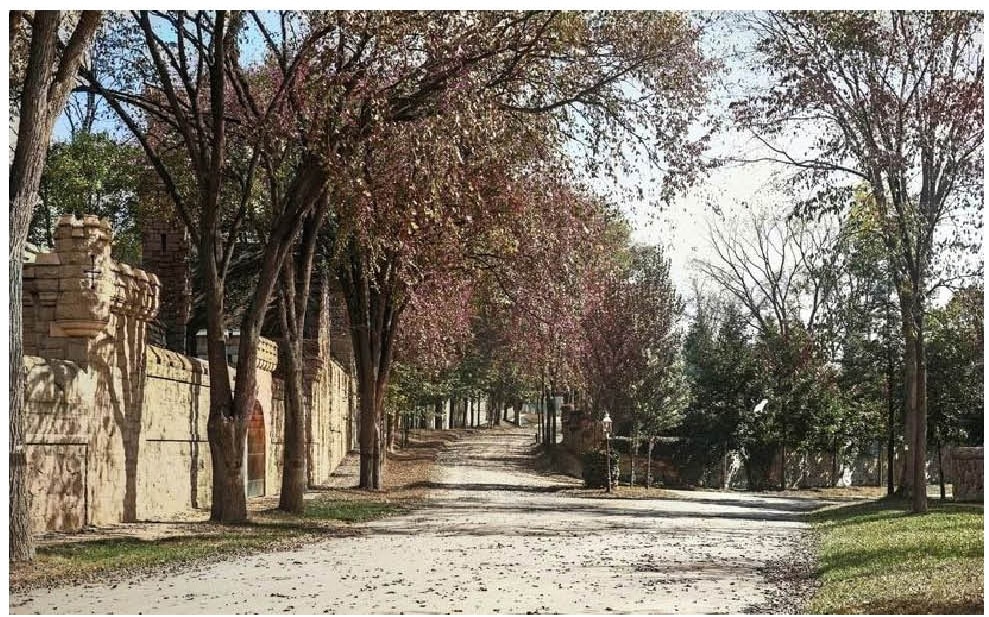
Old Entrance to East Street by Pine Lodge, about the 1890s.

Old East Street in front of Searles’ Pine Lodge Estate, about 1900.
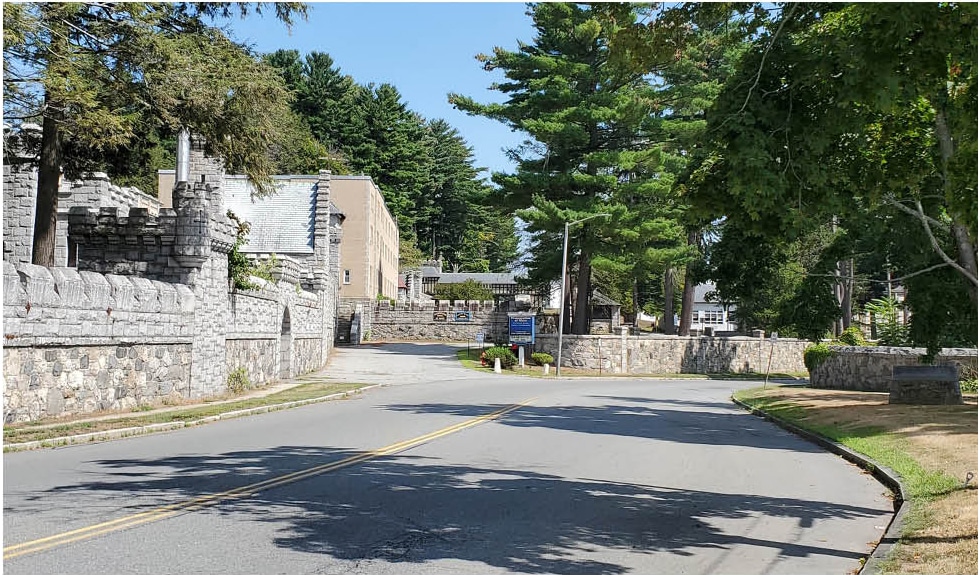
Shown in 2023, this in the former entrance to East Street and later entrance to Pine Lodge (note the newer convent building on the former site of Searles’ Pine Lodge mansion). Photo by Ken H. Doherty

Former East Street in front of the former Pine Lodge Estate, in 2023. Photo by Ken H. Doherty