A true lover of books will tell you that there is more to their passion than the appreciation of a good story. It might be the simple appeal of a freshly cracked-open paperback, or the rich texture and slight heft of an expensive hardcover. Some will say that there is nothing more alluring than the musty scent of an antique book, conjuring thoughts of previous readers from years past.
Book lovers often display their collections in interesting patterns, from stacks on the floor to meticulously color-blocked classics to the latest controversial design trend of spine-inpages-out. One local artist and self-proclaimed “weird book person” takes her love for books to the next level by turning ordinary books into extraordinary art.
Dael Angelico-Hart has spent a lifetime surrounded by books. As a doctor of literacy and reading, she shared her passion for the written word for 50 years. And while she no doubt had an appreciation for the physical qualities of books both new and old, it wasn’t until she saw an “altered book” in a local shop that her eyes were open to new ways to honor them.
“The first time that I saw an altered book it was like Mozart seeing a piano for the first time,” she says. “Not that I am comparing myself to Mozart,” she laughs, “but seeing this book covered in artwork and ephemera, I felt strongly connected to the art form. I immediately signed up for a workshop.”
Thirty years after that first foray into the craft, Angelico-Hart continues to transform books into pieces of art. Her home studio is chock full of a wide array of materials, from brass plumbing fixtures to bits of delicate lace. And throughout her busy life of family, theater, friends and travel, she has always made time to create her art.
“It began with making gifts for people, but very often I would love the piece so much that I would make a similar one for myself,” she says.
Soon she had a fan base, as well as a growing collection of altered books to display on a bookshelf in her home. The art of book alteration dates back to the Victorian era, when it was often used as a form of scrapbooking. The art form gained momentum in the 1960s and ’70s, and by the late-20th century it was a recognized form of mixed-media art. While purists might balk at the thought of desecrating a perfectly good novel, altered book artists will assure you that they do not seek out rare vintage books, but use those that might sell for a dollar in a used bookstore, or perhaps never sell at all.
“Sometimes, when I buy a book in a used bookstore, I wonder how the seller or author would feel if they knew what I was doing to it,” says Angelico-Hart, “yet I feel that I am giving it a second life.”
Angelico-Hart describes her process as not at all straight-forward.
“I sometimes make a list before I begin, of materials needed, my theme, etc. Sometimes the book title inspires the theme, but not always,” she says. “For some projects, I might have a basic idea of what I would like to do, and I go into the studio and just begin gathering any and all materials that relate. At some point, the materials might suddenly begin to drive the theme. It’s a road between planned and spontaneous. And, although I don’t like messes, it must get messy, as I spread everything out for the project.”
Some books are ripped into to remove half of the pages. Others have the spine removed. Some remain intact, as the artist adds paint, photos, ink and other materials to certain pages. Throughout the process, the original form of the book is treated with respect, as it is resurrected into a work of art. The transformation is sometimes minor; other times the book takes on an entirely new life. Angelico-Hart has added pages made of metal, wood and even glass to her books.
“But these books are meant to be picked up, touched and read,” she adds, “although some are a bit fragile.”
The artist has always photographed libraries when she traveled, and she plans to create an altered book featuring international libraries at some point. Interestingly, her own home might just be in one of the photos. Eleven years ago, she bought and moved into the old Groveland library, a building that had been a haven for book lovers like herself for close to 100 years. As she made the library her home, Angelico-Hart honored both the building’s history and her passion for books, building a shelf made entirely from books, displaying her altered books on a series of shelves, and lettering a quote from Emily Dickinson around the ceiling of one room.
“There is no Frigate like a Book,” the quote begins, “To take us Lands away.”
Now nestled in her own private world of books, bookshelves and book art, she is still a bit amazed at her luck.
“I was downsizing from a big family house,” she recalls, “and I told the Realtor to call me if she found anything ‘magic’. The library had just gone on the market. It was all meant to be.”
Patricia Bruno is a Methuen native, currently living in Haverhill. A writer and photographer, she is also the owner of The Winged Rabbit gift shop in downtown Haverhill.
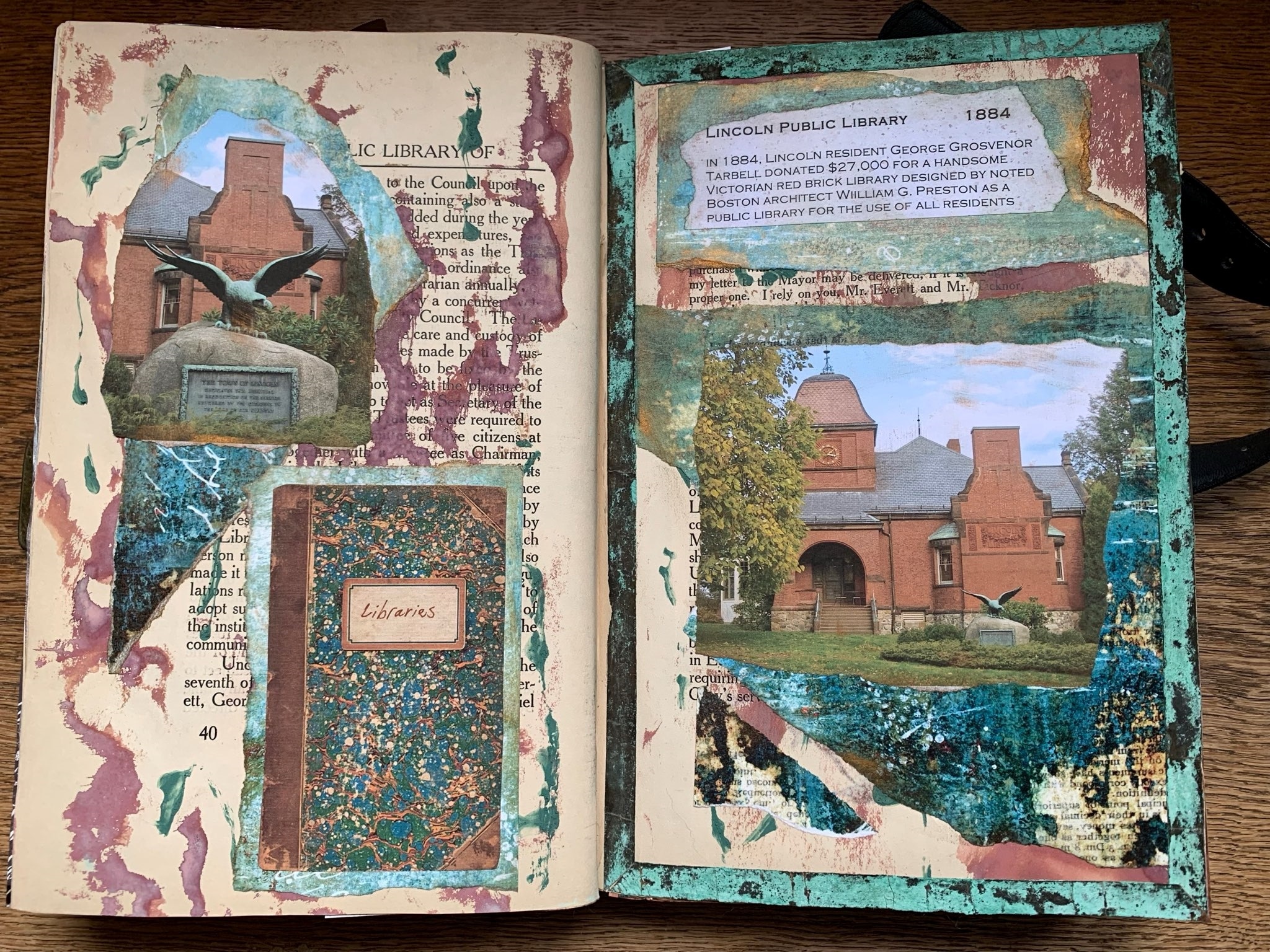
The interior of this New England Libraries book contains photos and snippets of facts.

The art of book alteration dates back to the Victorian era, when it was often used as a form of scrapbooking. Embellished with a pair of eyeglasses and a leather belt, this altered book by artist Dael Angelico-Hart features libraries of New England. Courtesy photos

The metal pages of this book hold magnets from the artist’s travels.