This beautifully maintained building at 30 River Street dates back to 1831. Historically, it is known as the John Tenney house. Later in the century, it was the Methuen Company cotton mill agent’s residence. It’s a great house, but it had seen much sadness in its early life.
John Tenney (no immediate relation to his contemporary, John F. Tenney, father of millionaire hat merchant Charles H. Tenney) was born in Dunbarton, N.H., in 1799. He graduated from Dartmouth College in 1824 with a law degree. He then settled in Methuen soon after and established an office above the Methuen Company store on Hampshire Street. He was the town’s first lawyer at a time when the Spicket Falls area was becoming industrialized and the population of the surrounding village was growing. He served for several years as a town selectman and as a town meeting moderator. He also served at the state level as a representative and a senator in the Massachusetts legislature and as a member of the Executive Council.
John married Mary Augusta Bartlett of Haverhill in 1830. The following year, he purchased 8 acres of land on River Street, upon which he built this house. It was one of the finer homes in Methuen at the time. Despite being only a short distance from the busy cotton mill, the acreage around the house was very rural. The railroad line behind the house didn’t exist until 1848-49 – and neither did Railroad Street. Only a few other houses existed nearby on Osgood Street, including the one that later became Shadi’s Restaurant.
River Street was part of an old road running southward from the Spicket Falls over Tower Hill and down to the Merrimack River at Bodwell’s Ferry near the present site of the Lawrence Water Treatment Facility on Water Street. It was a main route to the river before the Turnpike (Route 28) was built in 1806.
Sadly, Mary died in 1837 after giving birth to the couple’s fourth child, Mary Augusta Tenney (later married to the long-time town official and historian, Joseph S. Howe). Tragedy struck the family in 1839 when John and Mary’s oldest child, 7-year-old Margaret, drowned while playing with other children on the banks of the Spicket River.
John married for a second time to Augusta Sprague in 1843. The couple had four children. He died in April 1853 of consumption (tuberculosis) at the age of 54. Consumption was a common cause of death in those times. He was survived by Augusta and seven children from his two marriages – all under the age of 20. His youngest child was only 10 months old. He was one of the first to be interred in the newly established Walnut Grove Cemetery.
On Christmas Day of that same year, John’s son from his first marriage, Edward J. Tenney, age 20, drowned at sea while sailing to Chile aboard the ill-fated steamship San Francisco. The ship encountered a violent storm and sank about 200 miles east of South Carolina.
Augusta struggled financially to pay the mortgage after John died. She sold the property in 1858 to Methuen attorney John Davis. She then moved with her children to Andover where she ran a boarding house for students at Phillips Academy for several years.
John Davis was also a much-respected agent for the Methuen Company for many years until 1864. Mill agents in those times ran the local factories for the company. He then served as president of the Spicket Falls Bank until his death in 1874.
It doesn’t appear that John ever lived in the River Street house. He may have used it as a boarding house for mill workers. He sold it to the Methuen Company in 1866. The company used it as the mill agent’s residence for many years after.
John H. Morse took over as mill agent in 1871 and moved into the home with his new bride, Helen. John proved to be a capable and efficient manager, overseeing the great expansion of the mill and its production line. The company prospered greatly under his leadership.
In 1890, the townspeople were shaken by the sad news that John had taken his own life behind the mill’s office on Osgood Street. He was said to have been despondent over some unrelated business failures. He left behind his wife and two children aged 18 and 7. His widow vacated the home on River Street shortly after and moved to High Street.
The next occupants of the agent’s house were the new mill agent, Lewis E. Barnes and his wife Carrie. Lewis left the company in 1907 and was replaced by Charles Collins. The Methuen Company closed in the summer of 1926 and the mill property was sold at auction the following year. Charles and his wife, Vesta, purchased the house in 1927.
Charles died in 1933. Vesta sold the property in 1937 to Fred and Kathleen Wilkinson. Fred was a plumber, and Kathleen was a beautician in a beauty shop. Fred died in 1958. Kathleen sold the property in 1960 to Habdel T. Fary. The family ran Fary’s Auto Sales on Lawrence Road in Salem, N.H., for many years. His son, James, sold the house to a development corporation in 1984. It’s been owned by various realty trust groups and limited liability companies (LLC) since then.
The Tenney house has been renovated in recent years as an office building and is in amazing condition inside and out. It is currently the offices of EPM Mortgage Company.
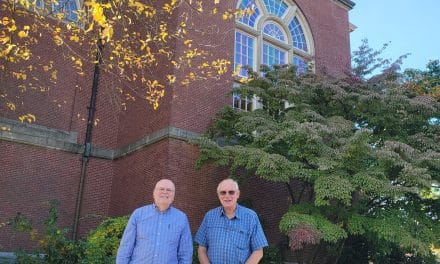
Ken Doherty is a lifelong resident of Methuen. He served on the Methuen Fire Department from 1980 to 2010. He is the Fire Department historian and a former member of the Methuen Historical Commission. He wrote “Á History of Methuen and its Fire Department” in 1996. He is retired and still living in Methuen with his wife, Paula.
-

- Today, 30 River Street houses EPM Mortgage Company. Photo by Kenneth H. Doherty
-

- This rural property at 30 River St., once belonged to Methuen’s first lawyer, John Tenney, and also served as the Methuen Co. agent’s residence for those in charge of local factories. 1906 photo